Extended Family
The mirror changed how we see ourselves. Now it’s changing our relationship with the rest of the animal kingdom.
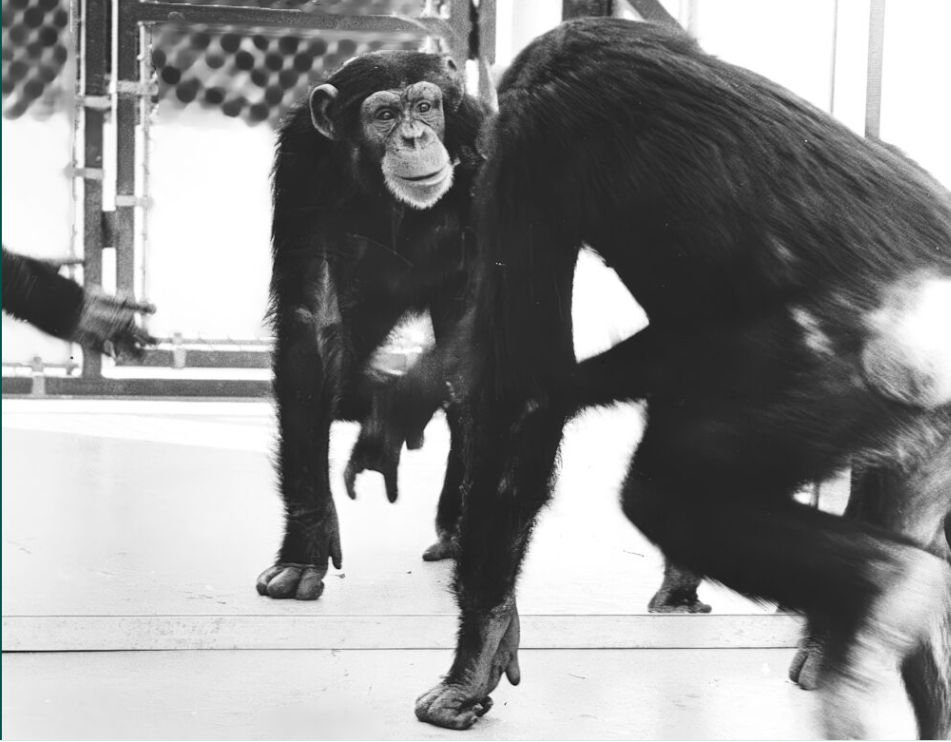
Chimpanzee Mindy during a mirror self-recognition study conducted at the University of Southwestern Louisiana, 1992.
Courtesy Daniel Povinelli
THE CLEANER WRASSE charged toward the unknown fish, ready for attack. The stranger met her head-on. When she retreated, the stranger did too. In due time, she began darting, flipping upside down, and “dancing.” Eventually, she approached more slowly, turning her blue body sidewise, then sank, all the time watching.
What appeared to be a stranger was, in fact, her reflection peering back. Days after the first encounter, biologist Masanori Kohda placed his small research subject in a solution of eugenol, an anesthetic made from clove oil, and injected brown dye under the skin of her throat—a spot she couldn’t see directly. When, later, the wrasse again looked in the mirror, she swam to the bottom of her tank and began to scrape her marked scales against a rock. In nearby tanks, other fish that had been similarly marked did the same.
Kohda and his colleagues concluded that the fish had recognized their reflections, a claim that sparked an uproar when the team from Osaka City University released the findings in 2019.
The study made the cleaner wrasse the latest to join an expanding and controversial pool of animals reported to share a capacity once thought uniquely human. Great apes, dolphins, elephants, certain birds, manta rays, and, most contentiously, ants had all reportedly passed the mirror mark test, the standard gauge of self-awareness in animals since 1970.
The test itself is appealingly straightforward. Mark an animal somewhere it can see only with the aid of a mirror. If the animal then touches or investigates the mark on its own body, rather than on the mirror’s surface, it has recognized itself.
But recognition, scientists had long held, required a self-concept onto which the reflected image could be mapped. And that faculty was widely believed to be absent in most animals. They might experience color, pain, and pleasure, the thinking went, but without any sense of the self having the experience. They simply didn’t have the brains for it.
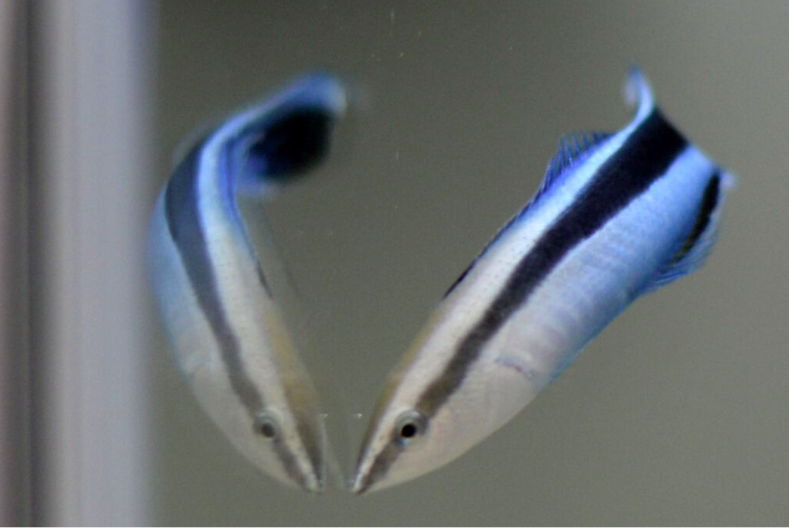
A cleaner wrasse in a research tank at Osaka City University, 2022.
Courtesy of Masanori Kohda
After the fateful 2019 study, however, the wrasse went on to pass multiple variations of the mirror mark test, accumulating evidence that now surpasses that for any other nonhuman animal.
Many researchers who had previously accepted the mirror test as the standard measure of self-awareness now began to look at it askance. The tiny fish had unwittingly shaken faith in a hypothesis the test’s creator had defended for half a century and whose root reached back further still: that self-awareness had developed just once in the animal kingdom.