
Science writer & editor
Andrea Teagle
Extended Family
The mirror changed how we see ourselves. Now it’s changing our relationship with the rest of the animal kingdom.
The mirror changed how we see ourselves. Now it’s changing our relationship with the rest of the animal kingdom.
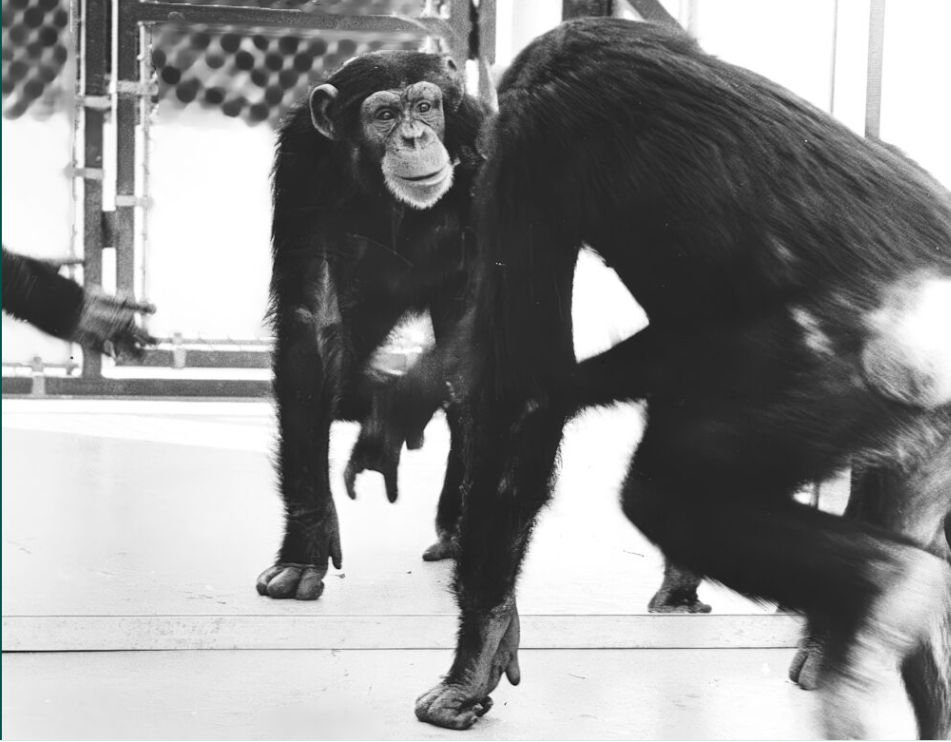
Chimpanzee Mindy during a mirror self-recognition study conducted at the University of Southwestern Louisiana, 1992.
Courtesy Daniel Povinelli
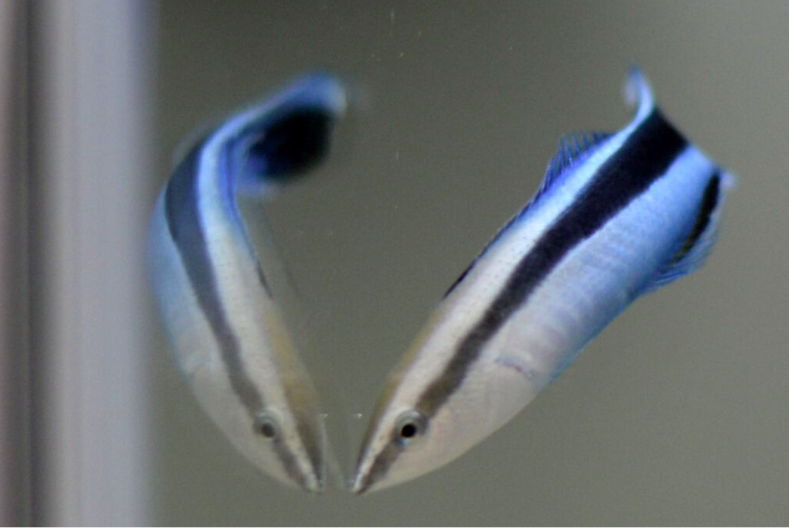
THE CLEANER WRASSE charged toward the unknown fish, ready for attack. The stranger met her head-on. When she retreated, the stranger did too. In due time, she began darting, flipping upside down, and “dancing.” Eventually, she approached more slowly, turning her blue body sidewise, then sank, all the time watching.
What appeared to be a stranger was, in fact, her reflection peering back. Days after the first encounter, biologist Masanori Kohda placed his small research subject in a solution of eugenol, an anesthetic made from clove oil, and injected brown dye under the skin of her throat—a spot she couldn’t see directly. When, later, the wrasse again looked in the mirror, she swam to the bottom of her tank and began to scrape her marked scales against a rock. In nearby tanks, other fish that had been similarly marked did the same.
Kohda and his colleagues concluded that the fish had recognized their reflections, a claim that sparked an uproar when the team from Osaka City University released the findings in 2019.
The study made the cleaner wrasse the latest to join an expanding and controversial pool of animals reported to share a capacity once thought uniquely human. Great apes, dolphins, elephants, certain birds, manta rays, and, most contentiously, ants had all reportedly passed the mirror mark test, the standard gauge of self-awareness in animals since 1970.
The test itself is appealingly straightforward. Mark an animal somewhere it can see only with the aid of a mirror. If the animal then touches or investigates the mark on its own body, rather than on the mirror’s surface, it has recognized itself.
But recognition, scientists had long held, required a self-concept onto which the reflected image could be mapped. And that faculty was widely believed to be absent in most animals. They might experience color, pain, and pleasure, the thinking went, but without any sense of the self having the experience. They simply didn’t have the brains for it.
A cleaner wrasse in a research tank at Osaka City University, 2022.
Courtesy of Masanori Kohda
After the fateful 2019 study, however, the wrasse went on to pass multiple variations of the mirror mark test, accumulating evidence that now surpasses that for any other nonhuman animal.
Many researchers who had previously accepted the mirror test as the standard measure of self-awareness now began to look at it askance. The tiny fish had unwittingly shaken faith in a hypothesis the test’s creator had defended for half a century and whose root reached back further still: that self-awareness had developed just once in the animal kingdom.
A Game of Cat and Mouse
A predator stalks Marion Island, and it weighs less than an ounce. Scientists are racing to stop it.
A predator stalks Marion Island, and it weighs less than an ounce. Scientists are racing to stop it.
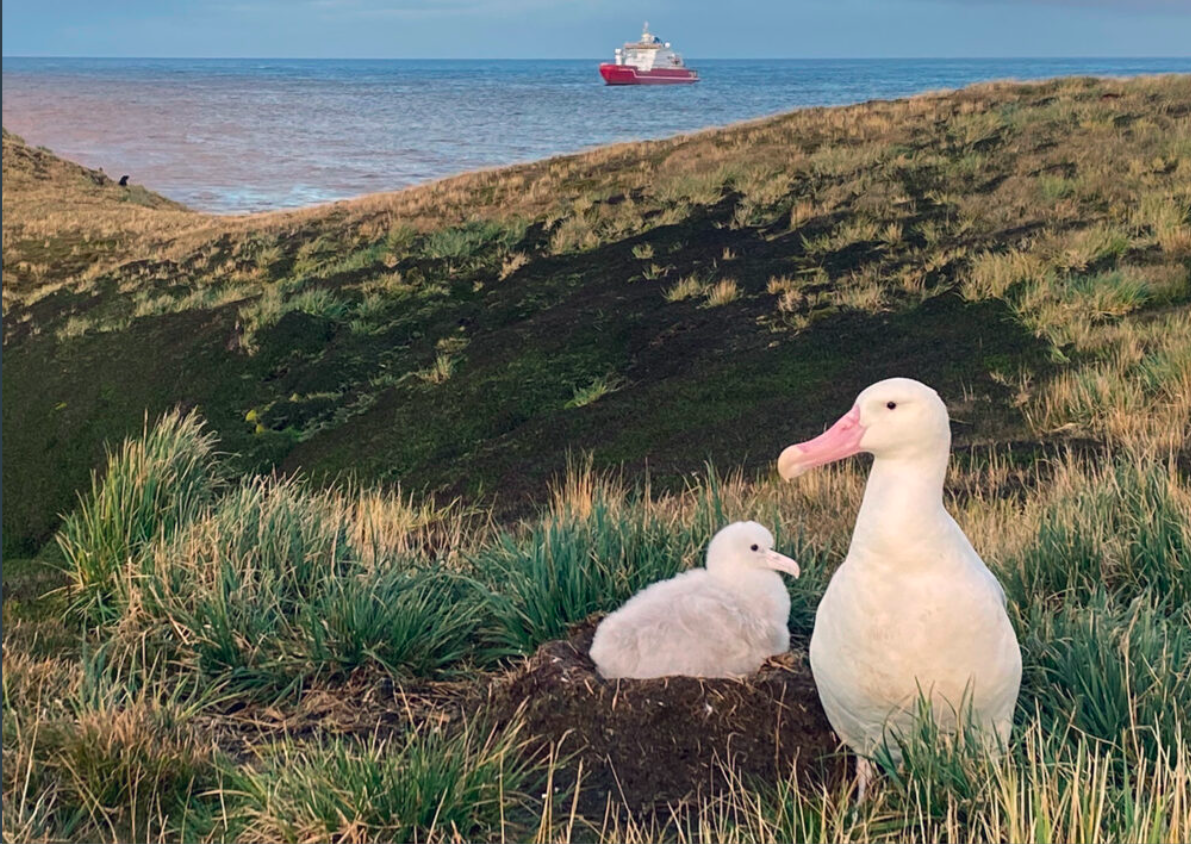
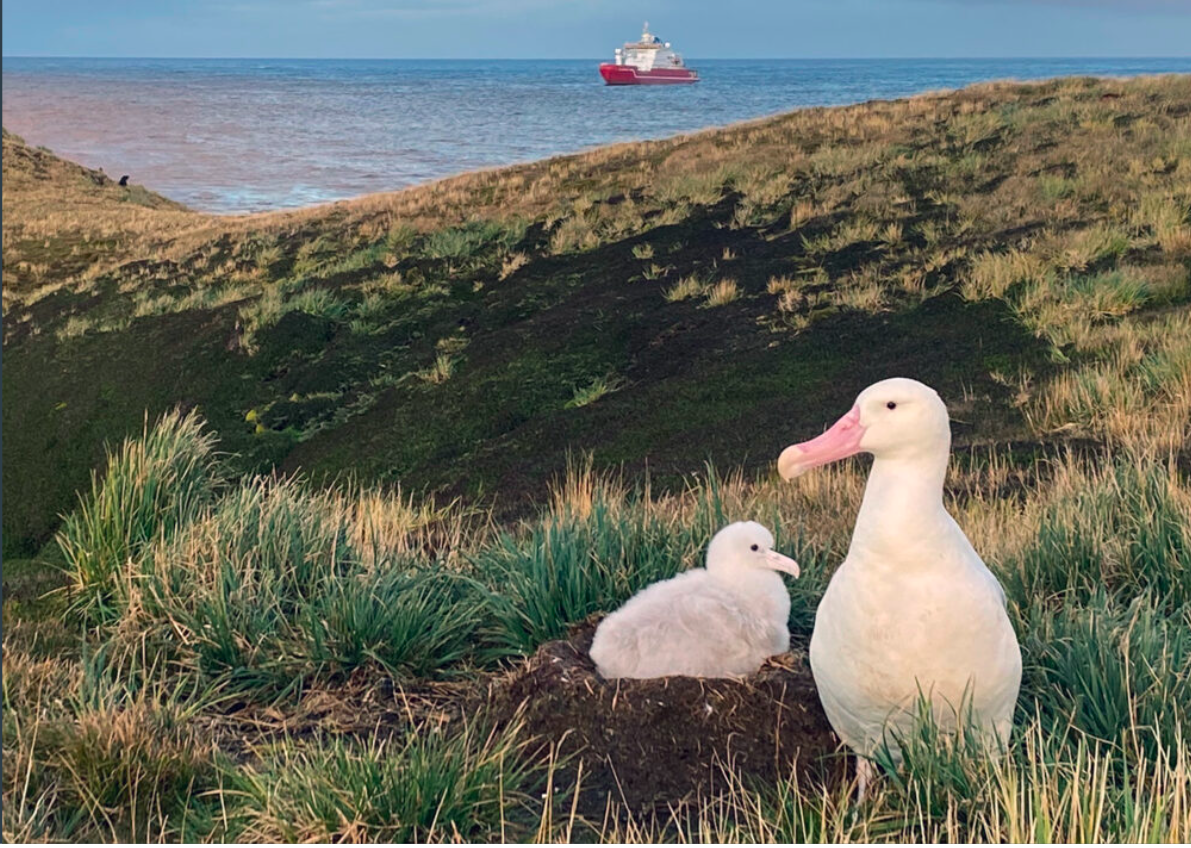
A wandering albatross and chick on Marion Island, 2023.
Source: Anton Wolfaardt/Mouse-Free Marion
At around nine months old, wandering albatross chicks leave their nests and take to the skies for the first time. Five years may pass before they again set foot on solid ground.
The young albatrosses navigate the Southern Ocean with a specialized sense of smell, locating squid and other prey up to 12 miles away. Their ability to hear infrasound may help guide their flight paths: the ocean’s low-frequency growls can travel thousands of miles, announcing large crashing waves and accompanying strong winds. Wanderers circumnavigate Antarctica two to three times a year on these winds, covering roughly 75,000 miles. By weaving between fast and slow layers, they stay aloft with barely a wingbeat.
Over the course of a 50-year lifespan, one may travel 5.3 million miles—the equivalent of 11 trips to the moon and back. But the drive to mate means that, from the age of about 10 onward, every other year adult albatrosses will navigate back to the pinpricks of land where they were born to reunite with their mates and raise a single chick. For many of the world’s wandering albatrosses, that place is Marion Island.
Located halfway between South Africa and Antarctica, Marion Island is not a stereotypical island paradise: it is windswept, cold, and constantly wet. The island is the summit of a huge underwater shield volcano rising 3 miles from the seabed. Marion’s Mascarin Peak coughed up gas and lava stones as recently as 2004. Usually, though, the island’s slopes are dusted with snow. Further down, where the albatrosses nest, marshy plains ripple with cushions, ferns, and other low-lying plants that can survive the Roaring Forties, the notorious westerly winds. To the northeast, Marion’s sister island, the tiny, cliff-edged Prince Edward Island, is visible on the horizon.
Despite—or because of—their desolation, these islands have long been the breeding sites of millions of rare seabirds: parades of penguins, fleets of burrowing petrels, and, of course, rookeries of wandering albatrosses. Then, in the early 19th century, humans disembarked, bringing with them an unlikely predator.
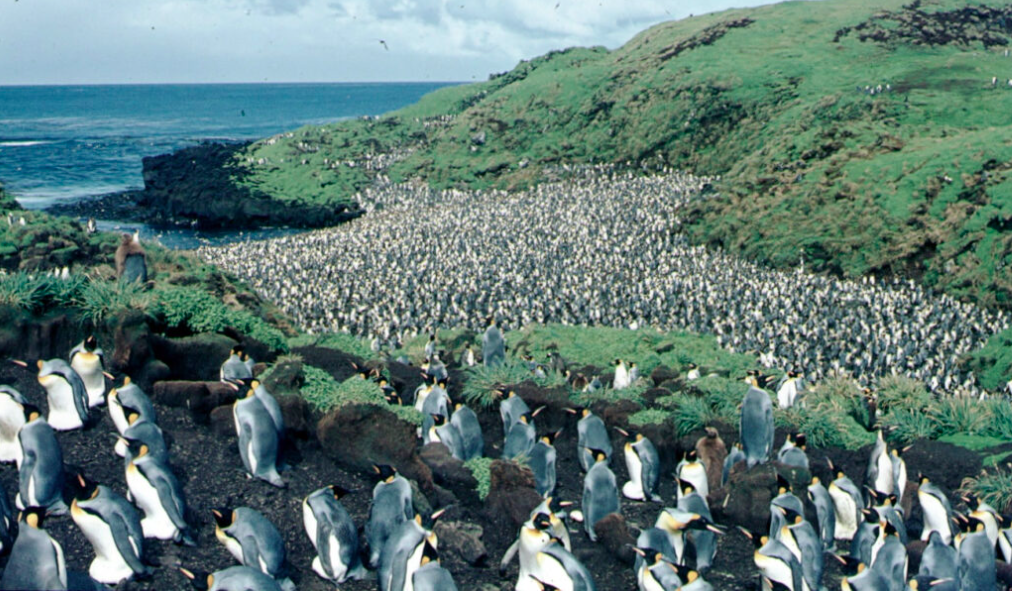
A king penguin colony on Marion Island, 1972.
Valdon R. Smith/Antarctic Legacy of South Africa
Some 200 years after its accidental arrival, the tiny house mouse has discovered what cats and men had long known: for all their aptitude at sea, pelagic birds make for easy prey. In 2019, photographer Thomas Peschak visited Marion Island to document the increasingly brazen mouse attacks. “In this landscape of black and green and grey, there is this red that pops out at you all of a sudden,” he recounted on the National Geographic podcast Overheard. “You come around this boulder, and you are literally looking at a bird that has been scalped.”
Since Peschak’s visit, bird casualties have mounted. If left uncontrolled, experts predict the mice could drive 18 of the islands’ 28 bird species to local extinction, some within the next three decades. That would wipe out a third of the global breeding population of wandering albatrosses and white-chinned petrels. Over time, the island itself would become ecologically unrecognizable. And so scientists and conservationists have hatched a plan to save the seabirds and restore Marion’s imperiled ecosystem.
Inspired by past eradication programs, South Africa’s Mouse-Free Marion Project aims to rid the island of mice once and for all. Standing in its way are turbulent sub-Antarctic weather conditions, 30,000 hectares of craggy mountains, boot-sucking bogs, and the harsh reality that success is guaranteed only if every last mouse is killed.