Achieving lasting remission for HIV
People infected with HIV must take antiretroviral drugs for life. But promising trials using engineered antibodies suggest that ‘functional cures’ may be in reach.
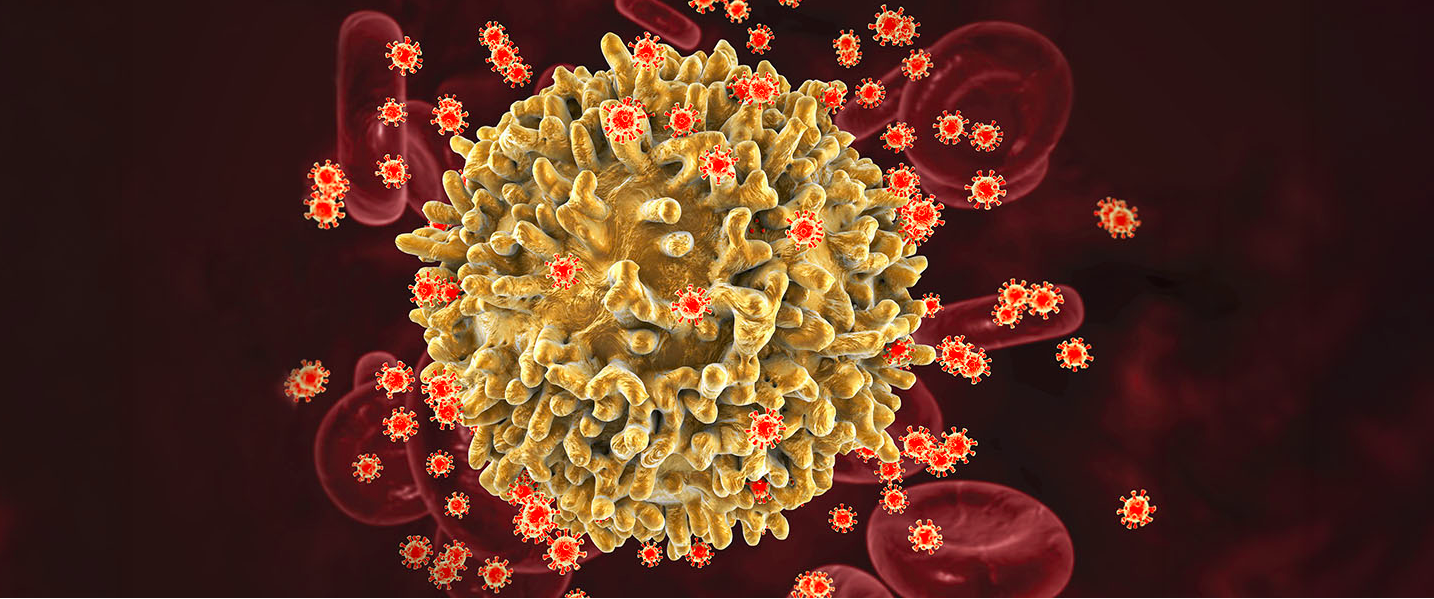
A digital illustration of an HIV-infected T cell. Once infected, the immune cell is hijacked by the virus to produce and release many new viral particles before dying. As more T-cells are destroyed, the immune system is progressively weakened.
Source: KATERYNA KON / SHUTTERSTOCK
Around the world, some 40 million people are living with HIV. And though progress in treatment means the infection isn’t the death sentence it once was, researchers have never been able to bring about a cure. Instead, HIV-positive people must take a cocktail of antiretroviral drugs for the rest of their lives.
But in 2025, researchers reported a breakthrough that suggests that a “functional” cure for HIV — a way to keep HIV under control long-term without constant treatment — may indeed be possible. In two independent trials using infusions of engineered antibodies, some participants remained healthy without taking antiretrovirals, long after the interventions ended.
In one of the trials — the FRESH trial, led by virologist Thumbi Ndung’u of the University of KwaZulu-Natal and the Africa Health Research Institute in South Africa — four of 20 participants maintained undetectable levels of HIV for a median of 1.5 years without taking antiretrovirals. In the other, the RIO trial set in the United Kingdom and Denmark and led by Sarah Fidler, a clinical doctor and HIV research expert at Imperial College London, six of 34 HIV-positive participants have maintained viral control for at least two years.
These landmark proof-of-concept trials show that the immune system can be harnessed to fight HIV. Researchers are now looking to conduct larger, more representative trials to see whether antibodies can be optimized to work for more people.
“I do think that this kind of treatment has the opportunity to really shift the dial,” Fidler says, “because they are long-acting drugs” — with effects that can persist even after they’re no longer in the body. “So far, we haven’t seen anything that works like that.”
People with HIV can live long, healthy lives if they take antiretrovirals. But their lifespans are still generally shorter than those of people without the virus. And for many, daily pills or even the newer, bimonthly injections present significant financial, practical and social challenges, including stigma. “Probably for the last about 15 or 20 years, there’s been this real push to go, ‘How can we do better?’” says Fidler.